


by Shannon Massara, Director of Client Success & Training, Dakota Group LLC, on May 05, 2026
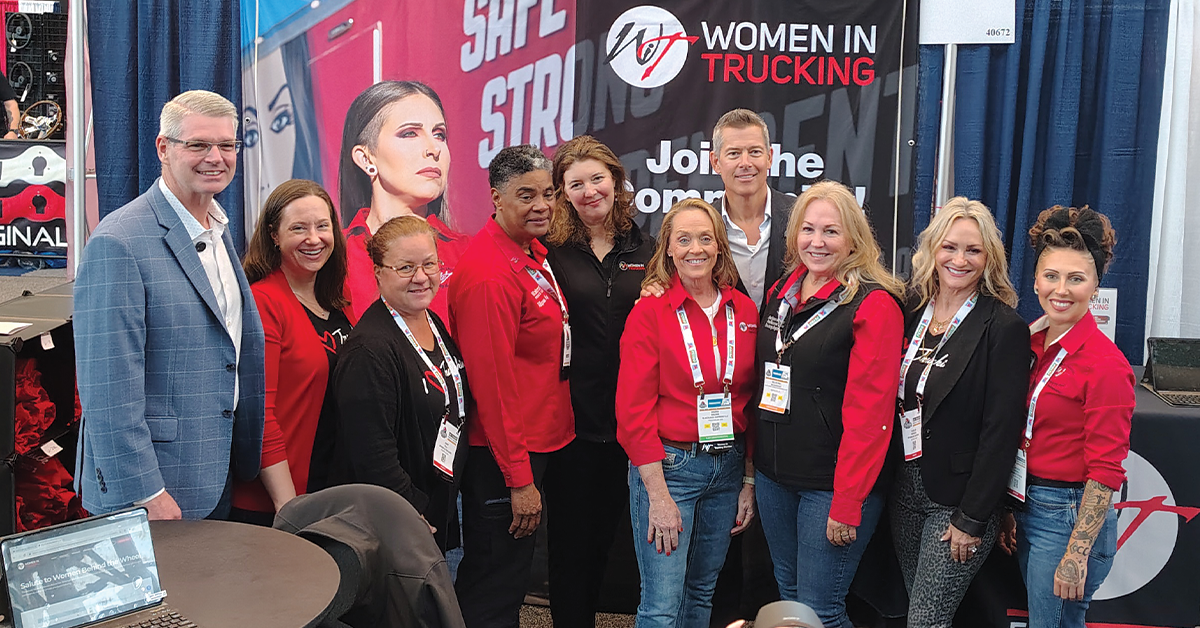
FMCSA Administrator Derek Barr (far left) and U.S. Secretary of Transportation Sean Duffy (back row) spent time with staff and volunteers at the Women In Trucking booth March 20 during the 2026 Mid-America Trucking Show in Louisville, KY.
 Shannon Massara is a WIT member who recently sat in on an educational session featuring Derek Barrs, Administrator of the Federal Motor Carrier Safety Administration. The Women In Trucking Association (WIT) has maintained a productive relationship with FMCSA over the years and continues to current foster this relationship with Administrator Barrs. Here are perspectives from Ms. Massara. Her insights and observations are her own and do not necessarily reflect those of WIT.
I had the chance to sit in on an FMCSA session at MATS, and this one gave a very different kind of insight. It wasn’t focused on one specific issue; it was more about how the agency is thinking, what they’re prioritizing, and where things are headed.
Administrator Derek Barrs opened in a way that immediately set the tone. He talked about faith, family, community, responsibility, and service, and tied those values directly to the trucking industry. He made a point to recognize the people in the room, drivers, owners, fleet operators, technicians, trainers, and emphasized how much the agency values what they do.
You could feel the enthusiasm and how much he genuinely cares, not just about the industry, but about the people in it.
He said more than once, “I hear you, and I listen to you,” and referred to this as the “new FMCSA,” making it clear that this level of engagement is what they want to be known for moving forward.
At the same time, this wasn’t a soft message. What stood out was how strongly he tied everything back to safety. He spoke about serious crashes and fatalities he had responded to in his law enforcement career, and it was clear that from his perspective, this isn’t theoretical. It’s personal.
That part resonated with me. Earlier in my career, I worked in emergency response as a 911 dispatcher and later a paramedic, so I’ve seen firsthand how quickly things can go wrong and how those moments stay with you.
One thing that really stood out was his focus on making rules simpler and more enforceable. He said rules should be “trooper-proof,” meaning they should be clear enough that they’re easy to understand, easy to follow, and easy to enforce. That’s a bigger deal than it sounds, because it suggests FMCSA is looking at whether rules actually work in the real world, not just whether they exist.
That same idea carried into how they’re approaching hours of service. He talked about pilot programs that allow drivers to pause the 14-hour clock and expand sleeper berth flexibility, and emphasized that FMCSA wants real-world data from drivers instead of making assumptions. To me, that signals an effort to show they’re listening and willing to adjust, at least in certain areas.
But where the tone really shifted was around enforcement and fraud. That part was very direct. He discussed enforcement of English language proficiency, non-compliant entry-level driver training providers, non-domiciled CDLs, fraudulent ELDs, chameleon carriers, and weaknesses in the current registration system. There was no hesitation in how he addressed it. The message was clear: FMCSA sees these issues as serious problems and intends to act on them.
On entry-level driver training, he was especially blunt. He criticized the current self-certification model and said that if it were up to him, the system would be wiped out and rebuilt from the ground up. That tells me the FMCSA is looking at training quality as a major risk area, not just an administrative process. He shared that FMCSA has already removed over 7,000 noncompliant training sites across the country. And he made it clear that FMCSA is committed to reviewing all 16,000 training providers on the list.
The same kind of thinking came through with ELDs. He described self-certification there as problematic as well and said the agency is actively removing non-compliant devices from the market. Again, the tone wasn’t about small adjustments; it was about cleaning things up.
He was just as direct when talking about chameleon carriers and fraud in the system. That may have been one of the strongest moments of the session. He talked about carriers cycling through identities, multiple companies operating out of a single address, and bad actors exploiting gaps in the system. He said plainly that they are going after those carriers.
That ties directly into the modernization effort FMCSA discussed right after. Their team discussed how outdated systems have created inefficiencies and opportunities for fraud, and how the new MOTUS registration platform is designed to address them. The goal is to simplify processes, strengthen identity and business verification, reduce fraud, and bring everything into a more unified system.
That might sound like a technology update on the surface, but it’s really about tightening control and closing gaps. From their perspective, better systems mean better oversight, better data, and fewer opportunities for bad actors to slip through.
Overall, I took away from this session that FMCSA is trying to shift how it operates and how it's perceived. They want to be seen as more engaged and responsive to the industry, but at the same time, they’re making it clear they’re going to be more aggressive on enforcement, fraud, and safety risks.
What it really comes down to is this: FMCSA seems focused on tightening the parts of the system that have become too loose, too outdated, or too easy to work around, while also trying to show that they are listening to the people actually out there doing the job.
Walking away from that session, this is what stuck with me: FMCSA is trying to redefine itself. More accessible, more modern, but also more serious about enforcement and accountability. How that plays out in practice is something the industry will be watching closely, but that was clearly the direction they were signaling in the room.
Related Articles:
- WIT Rolls Into DC With Big Conversations—and a Holiday Tree
- Ingrid Brown’s Personal Journey in Advocacy: Beyond Delivering A Christmas Tree
- WIT Statement on Confirmatio of Derek Barrs to Lead FMCSA
- WIT Engages With FMCSA in “Our Roads, Our Safety” Campaign
- WIT Hosts “Touch A Truck” Tour for FMCSA’s Deputy Director
- WIT Announces FMCSA Administrator Meera Joshi to Keynote Annual Conference
- WIT Sends Four Appointments to FMCSA Safety Committees